
In brief:
- Protected archipelago off Hyères, consisting of Porquerolles, Port-Cros, and Le Levant
- National land and marine park, remarkable fauna and flora
- Trails, renowned vineyards, historic forts, preserved beaches
- Access by shuttle or water taxi year-round from Hyères
- Fragile site to be preserved: respect for the ecosystem is essential
A natural jewel off the coast of Provence
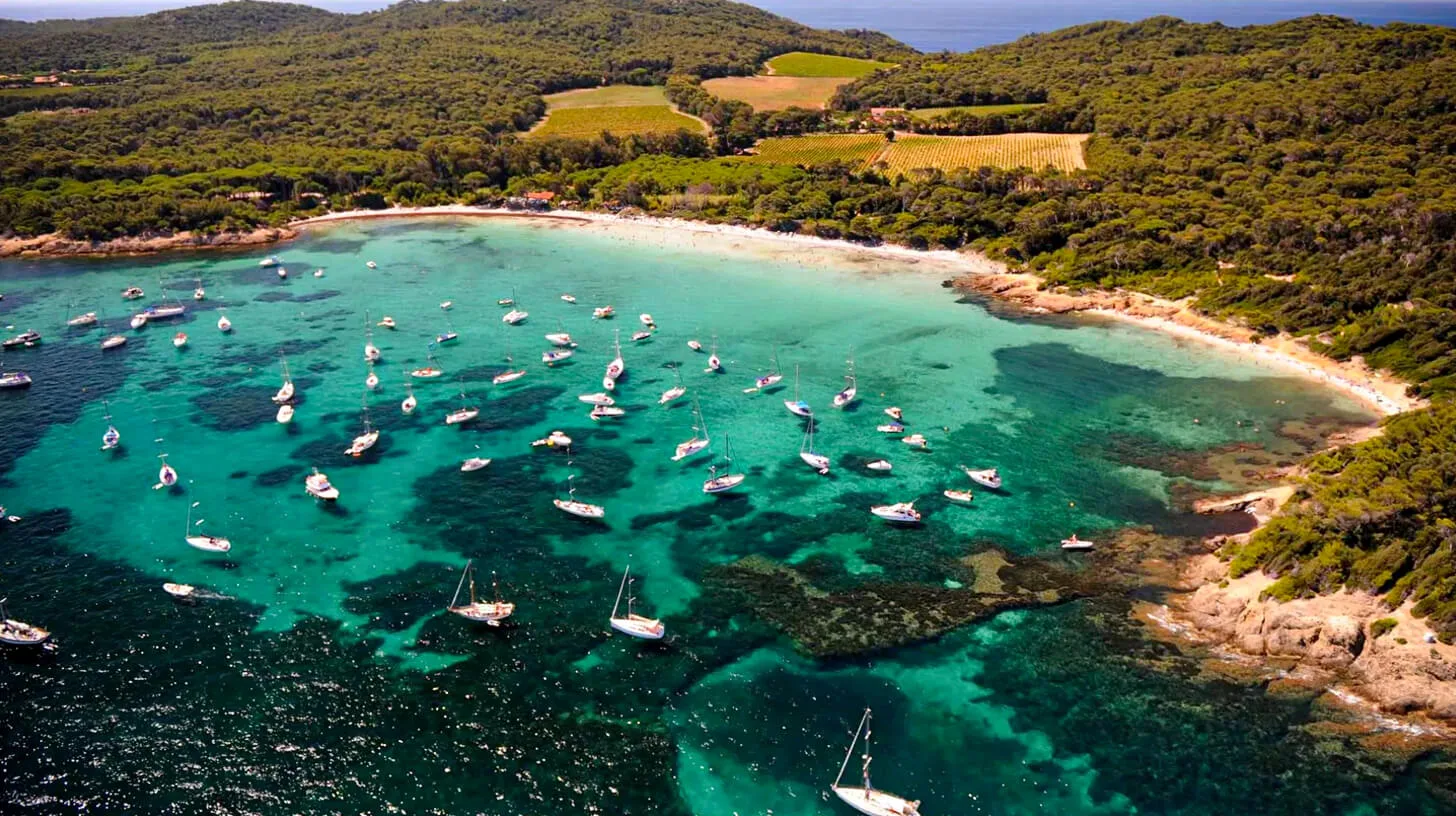
Located off the Giens peninsula, the islands of Hyères form an archipelago with remarkable ecological and historical richness. Also known as the Golden Islands, they mark the southernmost point of Provence and attract every year fans of untouched Mediterranean landscapes, hiking, diving, and heritage.
The archipelago consists of three distinct entities: Porquerolles, Port-Cros, and Le Levant. Each has its own identity, terrain, flora, and atmosphere. Connected to the mainland by shuttle, they can be explored on foot, by bike, or by sea, providing a total immersion in the heart of a protected area.
Porquerolles, the largest and most diverse
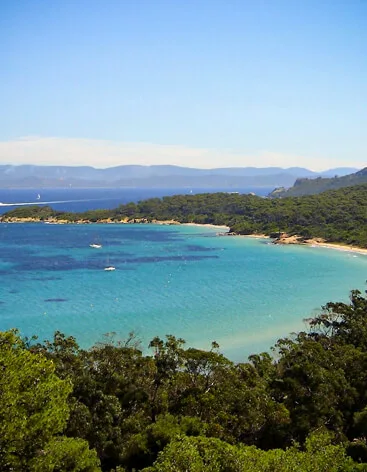
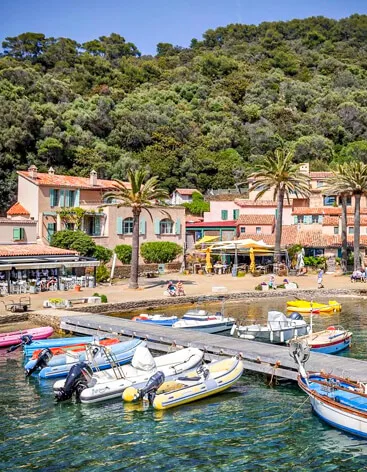
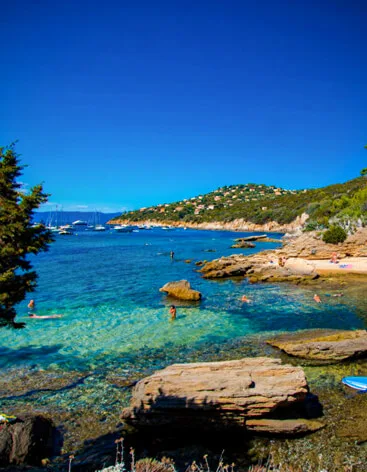
Porquerolles stretches 7 km long and 2.5 km wide, covering an area of 1,254 hectares. It stands out for the diversity of its landscapes, from sandy beaches in the north, steep cliffs in the south, ancient vineyards, and dense scrubland.
The central village, built around a dirt square, retains a peaceful atmosphere, with charming accommodations and shaded terraces. The heart of the island offers 54 km of trails to explore botanical and geological treasures, including the famous beaches Notre-Dame, La Courtade, and Le Langoustier.
Classified and protected since 1971, the island is also home to the National Botanical Conservatory, which works to preserve endemic fruit and plant varieties.
Port-Cros, a wild and mountainous sanctuary
Port-Cros is the steepest and most preserved of the three. Rising 194 m at the summit of Mont Vinaigre, this island is 4 km long and a haven of biodiversity. It is part of the first terrestrial and marine national park in Europe, established in 1963.
The trails lead to military remains such as Fort du Moulin or Fort de l’Estissac, while crossing typical vegetation: pine forests, dense scrub, and oak groves. The fauna is abundant, ranging from Cory’s shearwaters to mouflons, as well as endemic reptiles and rare butterflies.
Diving or snorkeling allows visitors to admire rich underwater landscapes: seagrasses, groupers, gorgonians, and nacres can be seen in clear, protected waters.
Le Levant, between wild nature and naturist tradition
Le Levant, more discreet but just as unique, is known for its naturist domain of Héliopolis, founded in 1931. The island extends 8 km long and 2 km wide, with 80% occupied by a military zone.
The rest of the territory, open to the public, reveals dense vegetation, majestic strawberry trees, and balcony paths leading to the rocky coastline. The beach of Grottes is reserved for total naturism.
From the port of Ayguade, visitors reach the village of Arbousiers and then the natural reserve of the Arbousiers domain, accessible via a network of marked paths. Wildlife and plant observation is particularly appreciated there.
Controlled accessibility and rules to respect
To preserve the fragile ecosystem of the islands of Hyères, several rules must be observed: no camping, no fires, dogs on leashes, no collection of plants. Smoking is strictly prohibited in forest areas.
Crossings take place year-round from Hyères or La Tour Fondue by maritime shuttle or water taxi. Expect about 15 minutes for Porquerolles and 1 hour for Port-Cros and Le Levant.
Useful contacts:
- TLV Porquerolles: 04.94.58.21.81
- TLV Port-Cros / Levant: 04.94.57.44.07
- TVM Vision des mers: 04.94.58.95.14
- Taxi Le Pélican: 04.94.58.31.19